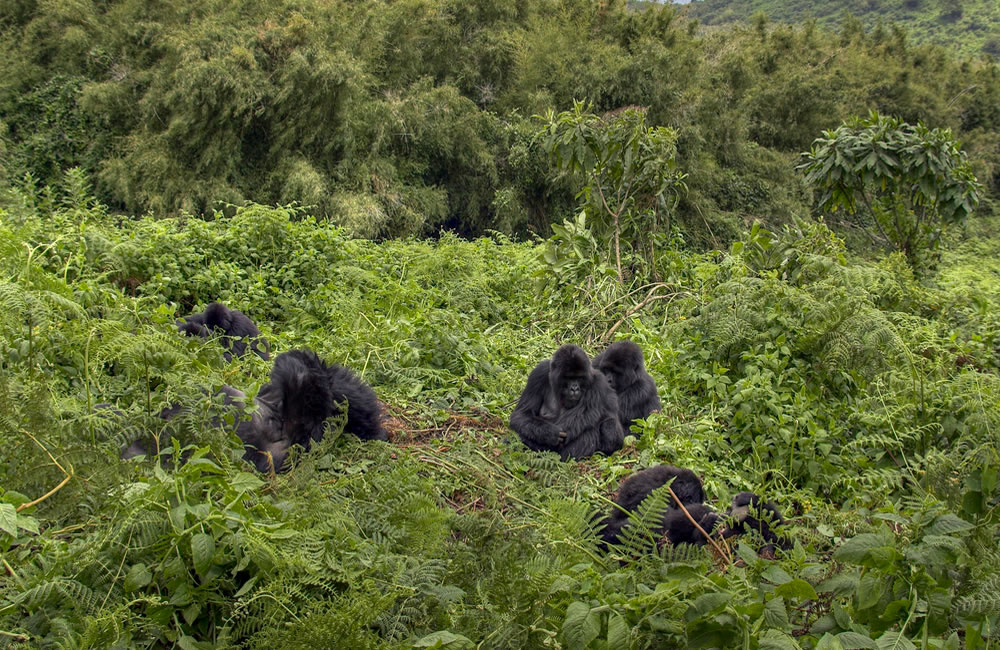
Tracking mountain gorillas in the Virungas or Bwindi Impenetrable national Park ranks among the absolute highlights of primates safaris in Africa. The exhilaration attacked to first setting eyes on a wild mountain gorilla is difficult to describe. These are enormous animals up to three times as bulky as the average man! Their size and power is not exaggerated by a shaggily luxuriant coat that covers its body.
Despite their fearsome look and appearance, gorillas have been known to be remarkably peaceable creatures when not provoked. Tracking them in the wild would be a considerably more dangerous pursuit if they were not peaceful! Most people believe that the gorillas posses the aggressive temper but this is not true. If gorillas possessed the temper of say vervet monkeys or baboons, or that of human beings, it would not be safe to visit them given their prowess. More impressive even than the gorillas’ size and bearing is their unfathomable attitude to people, which differs greatly from that of any other wild animal encountered. Anthropomorphic as it might sound, almost everybody who visits the gorillas experiences an almost mystical sense of recognition. Often, one of the gentle giants will break off from the business of chomping on bamboo to study a human visitor, soft brown eyes staring deeply into theirs as if seeking a connection a spine tingling wildlife experience without peer.
Gorilla tracking should not present a serious physical challenge to any reasonably fit adult whatever their age, but the hike can be tough going. Exactly how tough varies greatly, and the main determining factor is basically down to luck, specifically how close the gorillas are to the trailhead on the day you trek (one to two hours is typical, anything from 15 minutes to six hours possible ).
Another variable is how recently it has rained, which affects conditions underfoot- June to August are the driest months and March to May are the wettest. The effects of altitude should not be underestimated. Tracking in Bwindi Forest takes place at around 1,500m above sea level, but in the Virungas the gorillas are often encountered at almost 3,000m sufficient to knock the breath out of anybody who just flew in from low altitude. For this reason, visitors to the Virungas in particular might want leave gorilla tracking until they have been in the region for a week and are reasonably acclimatized most of Uganda lies above 1,000m.
Take advantage when the guides offer you a walking staff before the walk, this will be invaluable to help you keep your balance on steep hillsides. Once on the trail, don’t be afraid to ask to stop for a few minutes whenever you feel tired, or to ask the guides to create a makeshift walking stick from the branch. Drink plenty of water, and do carry some quick calories such as biscuits or chocolate. The good news is that in 99% of cases, whatever exhaustion you might feel on the way up will vanish with the adrenaline charge that follows the first sighting of a silver of a silverback gorilla.
Put on your sturdiest walking shoes for the trek, and wear thick trousers and long sleeves as protection against vicious nettles. It’s often cold at the outset, so bring a sweatshirt or jersey. The gorillas are used to people, and it makes no difference whether you wear bright or muted colours. Whatever clothes you wear are likely to get very dirty, so if you have pre-muddied clothes, use them.
During the rainy season, a poncho or raincoat might be a worthy addition to your daypack, while sunscreen, sunglasses and a hat are a good idea at any time of year, as are gloves to protect against nettles.
In all reserves, tourists are permitted to spend no longer than one hour with the gorillas, and may not eat or smoke in their presence. It is forbidden to approach the gorillas within more than 5m, a rule that is difficult to enforce with those curious youngsters (and some adults) who enjoy approaching human visitors, gorillas are susceptible to many human diseases, and it has long been feared by researchers that one ill tourist might infect a gorilla, resulting in the possible death of the whole troop should no immunity exist.
For this reason, you should not track gorillas when you have a potentially airborne infection such as a flu or cold, and should turn away from the gorillas if you need to sneeze in their presence , always wash your hands before you head out to the gorillas, do not leave rubbish in the park, whatever you bring into the forest should be carried back with you, the guides are responsible to take visitors where they left the gorillas the day before.
From there they follow the gorillas’ nesting sites along the way , when you approach the gorillas, the guides will inform you when to get your cameras ready. As for photography, my advice, unless you are a professional or serious amateur, is to run off a few quick snapshots, then put the camera away, enjoy the moment, and buy a postcard or coffee-table book later.
Gorillas are tricky photographic subjects, on account of their sunken eyes, the gloomy habitat in which they are often found, and a jet-black skin that tends to distort light readings. Flash photography is forbidden, so you are unlikely to get sharp results without a tripod or monopod. It might be worth carrying an ISO 800 or 1600 film ( or programming your digital camera appropriately ) in case you need the speed, but where light conditions permit, low-speed ISO 50 or 100 film will generally produce far better results.
Make sure, too, your camera gear is well protected if your bag isn’t waterproof, seal camera and films in plastic bags.
Above all, do bear in mind that gorillas are still wild animals, despite the ‘ gentle giant’ reputation that has superseded the old king kong image. An adult is much stronger than a person and will act in accordance with its own social codes when provoked or surprised. The most serious incident to date occurred while on a gorilla safari in Mgahinga National Park in 1997 when a silverback took exception to a professional photographer who decided that he was the exception to the flash photography rule. The gorilla snatched the camera and charged, roughed up and sat upon an innocent party who did/didn’t break a limb depending on which version of the story you hear.
The point, obviously is to listen to your guide at all times regarding the correct protocol in the presence of gorillas. Please always keep your voices low. You will also be able to observe the great birdlife and other wildlife in the forest.
Leave a Reply